June 15, 2026
ASC 606 revenue recognition: a guide for SaaS and subscription businesses


TABLE OF CONTENTS
RELATED POSTS


ASC 606 (Revenue from Contracts with Customers) is the FASB accounting standard that governs how and when companies recognize revenue. It requires businesses to recognize revenue when, and only when, performance obligations are satisfied.
Contrary to traditional business models where service delivery happens at the moment of the transaction, subscription services recognize revenue when the cash, per the contract, has been earned and not just collected.
A customer paying $1,200 upfront for an annual plan hasn't generated $1,200 in recognized revenue on day one. Under ASC 606, that revenue is recognized ratably — $100 per month — as the service is delivered.
For subscription businesses, the transaction price is typically the total consideration expected over the contract term–including all fees, charges, and variable considerations, such as usage-based fees or discounts.
Additionally, subscriptions have multiple performance obligations within a contract, and revenue recognition typically occurs over time because services are delivered continuously.
How does the five-step process of ASC 606 change the revenue recognition standard?
The five-step revenue recognition model sets the principles for revenue recognition in an annual reporting period for any business, regardless of industry or business model. As a subscription-based business owner, you'll notice how this framework makes room for companies just like yours.
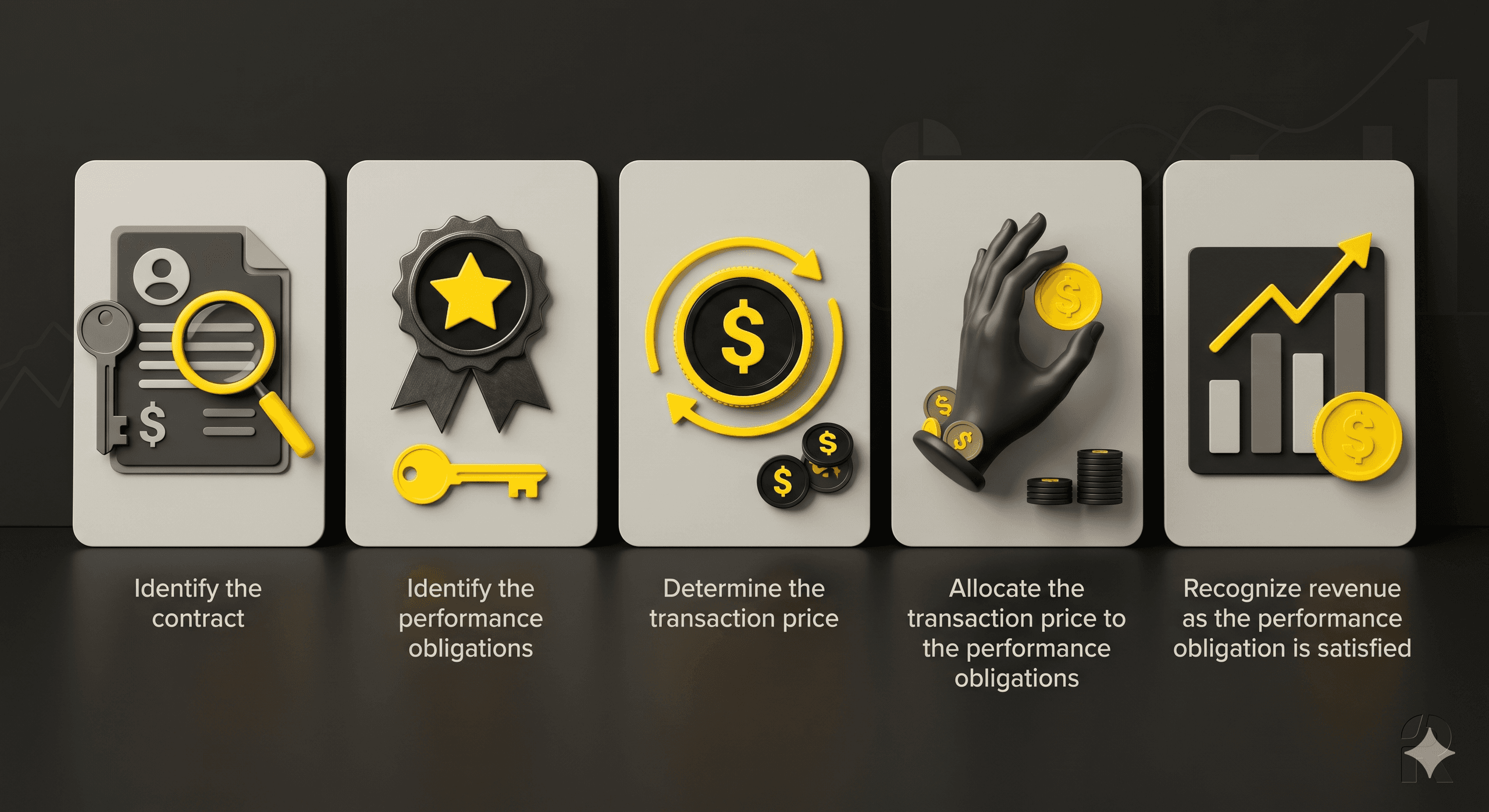
Identify the contract with the customer. Outline specific criteria to be met including obtaining approval with the customer, clearly defining rights and payment terms, ensuring the commercial substance of the product or service, and assessing the likelihood of payment fulfillment.
Identify the performance obligations outlined by the contract. Carefully analyze the terms and conditions of the contract to determine what service is provided to the customer to fulfill the contract.
Determine the transaction price. Calculate the contract cost and predict the total amount the company is entitled to receive from the customer. Transaction prices can include non-cash transactions, variable considerations such as discounts, add-ons, mid-cycle upgrades or downgrades, and any price concessions your business offers.
Allocate the transaction price to the performance obligations. Assign the total consideration price to performance obligations. These obligations include software licenses, implementation services, and ongoing customer support.
Recognize revenue when the entity satisfies a performance obligation. Revenue should be recognized when an entity satisfies a performance obligation by transferring promised goods or services to the customer. This ensures financial statements provide a more accurate picture of the entity's economic performance.
The need for each step in the ASC 606 revenue recognition standard depends on the business, but this is a great baseline to follow for compliance to properly gain revenue from contracts.
How to implement ASC 606 in your business?
While the five steps of the ASC 606 revenue recognition standard seem simple, implementing it can become a challenge. Additionally, the timing of revenue recognition can impact financial statements and have legal and tax consequences.
Recognizing contract revenue too early can lead to
Overstated revenue: It inflates a company's reported annual revenue figures, making it appear more profitable than it is.
Legal and regulatory issues: It can be considered fraudulent accounting, and violations of accounting standards can result in fines or penalties.
Tax implications: If a business pays taxes on income it hasn't earned yet, it may face tax issues and penalties.
Recognizing revenue too late can lead to
Understated revenue: It makes the business appear less profitable, affecting investor perceptions and the ability to secure financing.
Cash flow problems: The company may not have access to the revenue it has already earned for current expenses.
Compliance issues: Non-compliance can result in financial restatements and associated costs.
When you're worried about turning in the right financial statements to the IRS with the right ASC 606-10-20 revenue recognized, that's when you want to pick the ideal revenue recognition software for your business.
Using automation tools like Recurly can streamline the revenue recognition process by automating calculations, ensuring accurate recognition of revenue, and reducing the risk of errors. By implementing the 5-step revenue recognition process as outlined in ASC 606 and utilizing automation tools, your business can improve accuracy, efficiency, and compliance in revenue recognition practices.
Check this out: Five recognition must-haves for DTC subscriptions
Why does ASC 606 compliance matter for businesses?
Compliance is key for all entities to build trust and accountability with stakeholders. The ASC 606 standard creates clear methods of revenue recognition that make it easy for all companies to be consistent with accounting practices.
While core principles of financial compliance are universal, the regulatory environment and revenue recognition models can create challenges for nonprofit organizations and public and private companies.
Nonprofits, for example, face unique tax-exempt regulations, public companies must meet stringent securities regulations, and though private companies have more flexibility, they must adhere to accounting standards.
Implementing ASC 606 is as much a data project as an accounting one. Companies adopting or migrating to automated revenue recognition systems typically need to reconstruct historical balances. This means establishing what was recognized versus deferred before the system took over. Contract configuration errors, like incorrect term lengths or mismatched pricing, can produce SSP calculations that auditors won't accept.
ASC 606 requires more comprehensive disclosures than the standards accountants followed before. Still, its flexible framework allows your team to account for the uncertainty of revenue and deal with complex revenue scenarios.
Now, when your accountants talk about the comparability of revenue recognition, you can rest assured they can reach a point where they can compare apples to apples because non-profit, private, and public companies all follow the same principles for revenue recognition.
The compliance burden has real commercial consequences. Some subscription businesses have pulled annual plan offerings entirely — not because of customer demand, but because revenue recognition complexity under ASC 606 made them operationally untenable. Automated revenue recognition removes that constraint.
What is the impact of ASC 606 on different industries?
The subscription model creates exactly the conditions the standard was designed to address: recurring contracts, multi-element arrangements, and revenue that's earned over time rather than at a single point.
Three areas create the most complexity for finance teams.
Variable consideration. Most contracts include some form of variable pricing — usage overages, volume tiers, annual true-ups, or mid-cycle upgrades and downgrades. Under ASC 606, companies must estimate variable consideration at contract inception and update that estimate each reporting period. Getting this wrong in either direction has real consequences: overstatement inflates reported revenue, understatement understates it.
Multi-element arrangements. Enterprise SaaS deals typically bundle a software license, implementation services, and ongoing support into a single contract. Each of those components is a separate performance obligation under ASC 606. Companies must allocate the transaction price across each obligation at its standalone selling price.
Contract modifications. Mid-cycle changes — a seat expansion, a tier upgrade, adding a new module — each trigger a reassessment under ASC 606. The standard provides guidance on whether a modification creates a new contract or modifies the existing one, but the analysis requires judgment and documentation at every change event.
For SaaS businesses with high transaction volumes, manually managing these assessments across thousands of active contracts is where compliance risk accumulates. Automated revenue recognition software handles the calculation and documentation logic continuously, not just at close.
Frequently asked questions about ASC 606
What is ASC 606 revenue recognition?
ASC 606 is the FASB accounting standard that requires companies to recognize revenue when they satisfy performance obligations to customers — not simply when cash is received. It applies to all companies that enter into contracts with customers and is the U.S. equivalent of the international standard IFRS 15.
When did ASC 606 go into effect?
ASC 606 became effective for public companies for annual reporting periods beginning after December 15, 2017 (i.e., fiscal year 2018 for most calendar-year companies). Private companies had an additional year, with the standard effective for annual periods beginning after December 15, 2018.
Does ASC 606 apply to private companies?
Yes. Both public and private companies must comply with ASC 606. Private companies have access to certain practical expedients that reduce compliance complexity — including the portfolio approach and some disclosure simplifications — but the core five-step recognition model applies regardless of company type.
What is the difference between ASC 606 and IFRS 15?
ASC 606 and IFRS 15 were developed jointly by FASB and the IASB and share the same five-step framework. The primary differences are in transition method options and certain practical expedients available under each standard. For U.S.-based companies operating internationally, understanding both is important; in practice, the standards are largely converged.
What is the difference between ASC 606 and ASC 605?
ASC 605 was rules-based and included industry-specific revenue recognition guidance. ASC 606 replaced it with a single principles-based framework that applies across all industries. The shift required most SaaS and subscription businesses to update their revenue recognition policies, systems, and disclosures.
How does Recurly handle revenue recognition compliance under ASC 606?
More flexibility and personalization create the need for an automated revenue recognition platform. Subscription companies with complex revenue streams, such as different pricing tiers, billing frequencies, or contractual obligations, with high transaction volumes, or planning to scale, really benefit from automated revenue recognition systems.
Automated revenue recognition helps streamline operations, reduce errors, and ensure accurate financial reporting. And Recurly makes this a reality for our customers.
Our revenue recognition solution stays updated with the latest changes in accounting standards, including ASC 606. Those automatic updates roll over to our customers, automatically incorporating the criteria for revenue recognition, showing unrecognized revenue, and making it easier for accounting teams to track revenue over time.
Inside the automated revenue recognition process in Recurly
To grow limitlessly, recurring revenue businesses must be ready to adapt to evolving revenue recognition principles quickly.
Partnering with a subscription management and recurring billing platform ensures that business standards are understood and met with the expertise that is vital to compliance needs. Recurly's all-in-one solution offers:
Lower costs and a streamlined tech stack
Improved revenue visibility, reporting accuracy, and predictability
Accelerated financial closes
Reduced compliance risks
Support for changing business and accounting requirements
Direct-to-consumer subscription businesses must approach revenue recognition differently. Accurate Revenue recognition software is the answer for any growth-minded business looking to automate subscription revenue accounting.
With high-velocity, high-volume customer contracts and seemingly endless contract modifications, revenue recognition standards such as ASC-606–and IFRS-15 for businesses operating abroad–can easily become more complicated.
Check out this checklist with five revenue recognition must-haves for DTC subscription businesses.



